Tower Rush - Complete review 100% British
Tower Rush UK 2026 - Complete Game Review
This is the complete review after almost two months of use. Not a summary of the technical specifications. An honest account of what it means to play Tower Rush in 2026, with real data, mistakes made, and lessons learned.
The First Impact — What Strikes Immediately
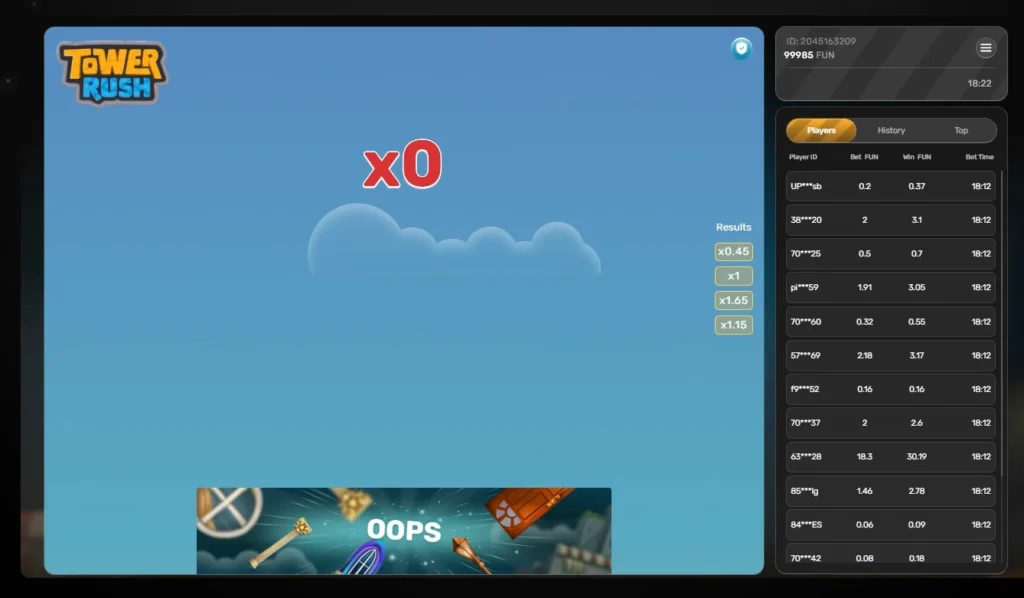
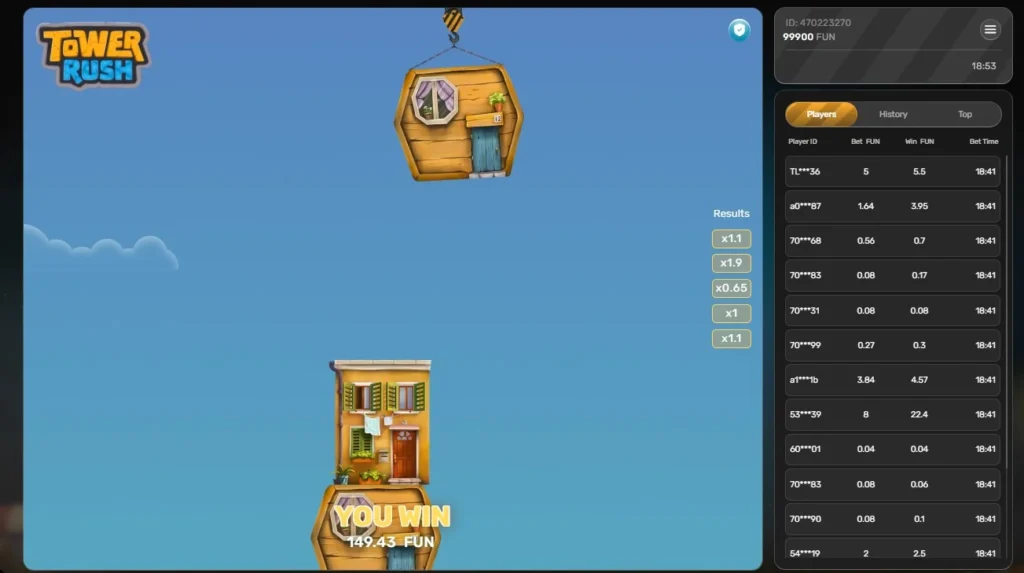
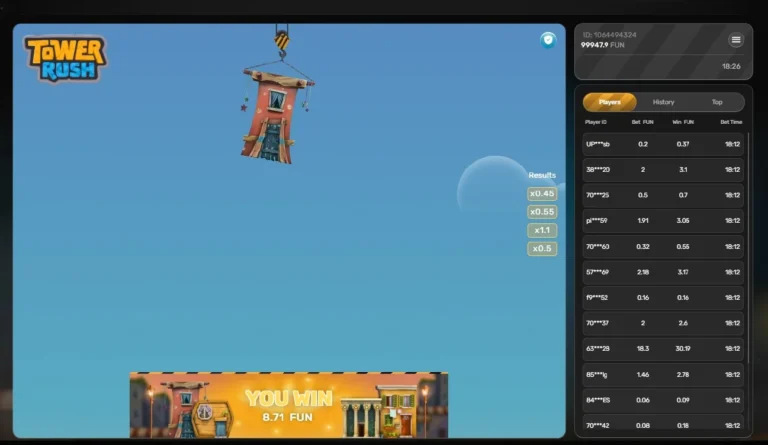
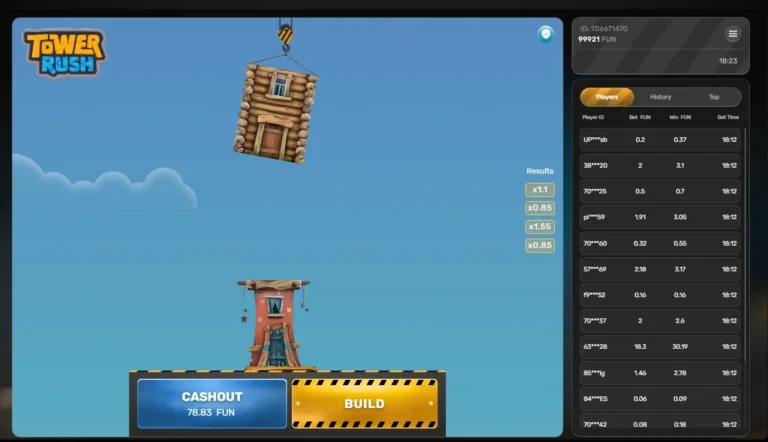
The simplicity. Tower Rush doesn't overwhelm you with rules, tutorials, or introductory screens. You press BUILD, a block swings, you release it at the right moment. If it lands well, the tower grows. If you mess up, everything collapses.
This linearity is deceptive. The first rounds seem like a child's game — wide blocks, slow crane, huge margins. Then you reach the fifth floor and the pace accelerates. On the seventh floor, every millisecond counts. On the tenth, your hands sweat even if you're playing in demo.
What really strikes you, after a few hours, is the sense of ownership. In Aviator you watch a curve rise and hope. In Tower Rush you build something. Every well-landed floor is your achievement. Every collapse is your fault. This direct responsibility creates a bond with the game that passive crash games do not reach.
The Mechanics Explained to Those Who Have Never Played
A round of Tower Rush works like this:
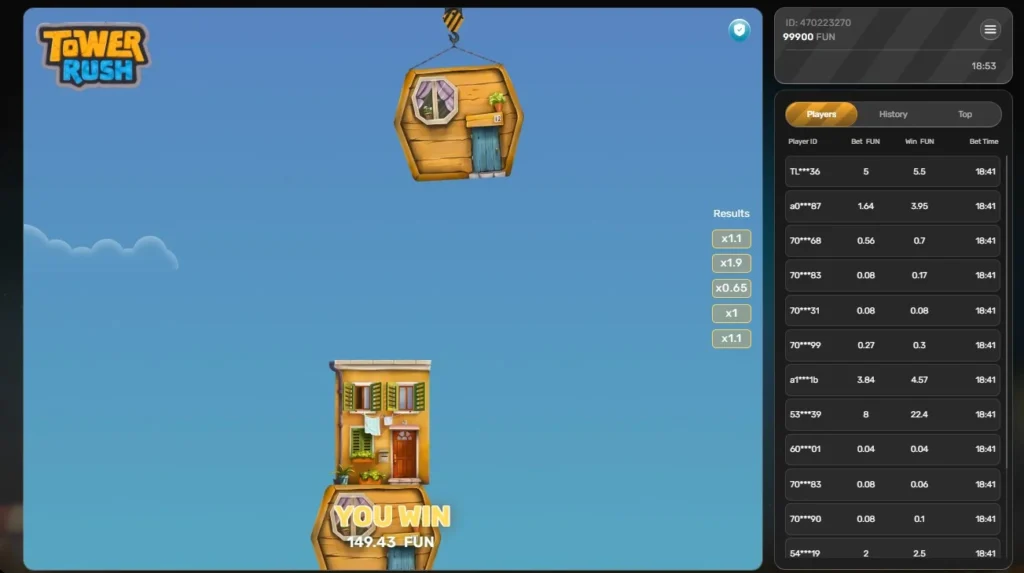
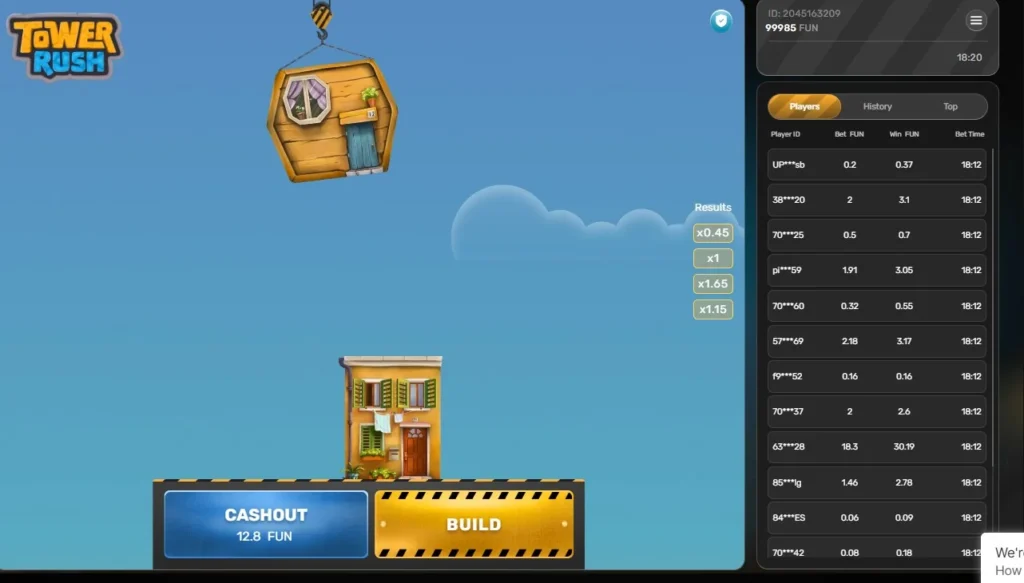
Choose your bet — from €0.01 to €100. Press BUILD. A block appears hanging from a crane that swings from left to right above the tower. The movement is constant, without sudden accelerations. You release the block when you think it is aligned with the underlying floor.
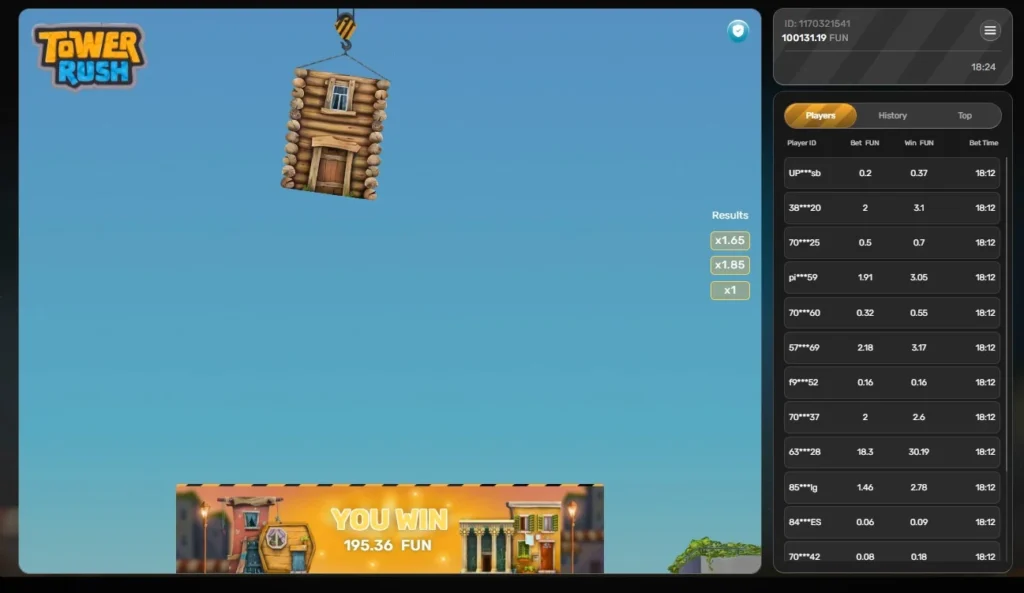
If the alignment is sufficient, the block lands. The tower grows by one floor. The multiplier rises. You can cash out immediately with the CASHOUT button or try for another floor.
If the alignment is insufficient, the tower collapses. Round over. Bet lost.
The difficulty naturally increases with height. The first floors offer wide margins for error. The intermediate floors (4-8) require increasing precision. The high floors (9+) demand almost perfect coordination.
There is no predefined limit to construction. You can continue as long as you can place blocks. The record? Forums talk about towers beyond the twentieth floor, but these are rare events that require exceptional skill and a good dose of luck with bonuses.
Why Tower Rush Has Conquered the UK Market
The crash game is not a new format in Italy. Aviator paved the way, Spaceman consolidated interest. But Tower Rush has intercepted a specific need: the desire for active participation.
Italian players — at least those I've spoken to in forums and communities — tend to prefer games where they feel they have a role. Traditional slots, with their passive spin-and-hope mechanism, are losing appeal among players under thirty. Tower Rush offers the opposite: every round requires a physical action, a timing decision, a cash-out choice.
The turbo format also fits Italian rhythms. Rounds of 10-30 seconds that you can play during a coffee break, on the subway, while waiting at the doctor’s. An hour of concentration is not needed. Five minutes of focus are required — and those five minutes are genuinely engaging.
Strategies That Work — and Those That Don’t
Let’s be clear: no strategy guarantees a win. The RNG determines the physics of the blocks, the house maintains a statistical edge in the long run. Anyone promising otherwise is selling something.
That said, the way you play influences your results. Some things I learned in two months.
It works: fixed target pre-round. Before pressing BUILD, decide the multiplier at which to cash out. x7? x10? Decide and stick to it. No exceptions. This discipline eliminates emotional decisions that eat away at bankrolls. In the first month, I ignored this advice. In the second month, I applied it. The difference in results was evident.
It works: proportional bets. Never more than 2-3% of the available balance on a single round. With €50 in the account, that means €1-€1.50 per round. It seems little. Surviving negative streaks is more important than maximizing positive rounds.
It works: short sessions. Fifteen-twenty minutes maximum. After that, accuracy drops and decisions worsen. I tracked my results by time slots: the first fifteen minutes produce a significantly better actual RTP than the last fifteen in half-hour sessions.
It doesn’t work: doubling down after a crash. The Martingale strategy — doubling the bet after each loss — drains the bankroll at a brutal pace during negative streaks. Six consecutive crashes (which happen regularly) doubling from €1 means a final bet of €64. With a €50 bankroll, you’re already out of the game.
It doesn’t work: chasing bonuses. Bonuses appear randomly. Building a strategy based on the expectation that the Frozen Floor will arrive “because it’s time” is a fallacy. Your strategy must work even in sessions completely devoid of bonuses.
It doesn’t work: playing tired. I learned this the hard way one Friday night. After a heavy day, my accuracy had visibly dropped — blocks that I normally land easily slipped away on the fifth floor. The result? Four crashes in a row and €4 burned in six minutes. Tower Rush requires active concentration for every single placement. If you don’t have it, the session isn’t worth it.
One aspect that is rarely mentioned in guides: managing the cash-out moment after a bonus. When the Frozen Floor activates and you push up to x18, the adrenaline is high. The next round — back to normal, without protection — risks seeming boring by comparison. The temptation is to force the game to replicate that excitement. Resist. Every round is independent. Return to your standard target and let variance take its course.
A Typical Week — Session Diary
Monday. Desktop, evening. Twelve rounds, bet €1. Four cash-outs at x5, x7, x6, x8. Six crashes on the lower floors. Two rounds voluntarily interrupted below x3 because concentration was dropping. Balance: +€4.30. Duration: 14 minutes.
Wednesday. Mobile, lunch break. Fifteen rounds, bet €0.75. Greater difficulty on small screen — my ceiling on mobile is level seven. Five modest wins (x3-x6). Frozen Floor at round eleven, pushed up to x14. Balance: +€3.20. Duration: 18 minutes.
Friday. Desktop, late afternoon. Negative session. Nine rounds, seven collapses. Two miserable wins at x3 and x4. No bonus. I stopped after eight minutes when I realized I was forcing placements out of frustration. Balance: -€4.10.
Saturday. Desktop, morning. The best session of the week. Twenty relaxed rounds. Frozen Floor + Triple Build in the same round — win at x22.4 on a bet of €1. Three other solid wins above x8. Balance: +€18.70. Duration: 22 minutes.
Weekly balance: +€22.10. The Saturday round with double bonus made the difference. Without that, the week would have been around +€3. This is the reality of high volatility — results heavily depend on a few key rounds.
Bonuses in Detail — Three Mechanics, Three Roles
Frozen Floor is the bonus that changes the rules of the round. It freezes the current multiplier as the minimum payout. If you are at x6 and it activates, that x6 is guaranteed even if the tower collapses right after. The strategic effect? Push higher. With the safety net active, every additional floor is pure potential gain.
In my experience, Frozen Floor appears about once every 9-11 rounds. Rounds with Frozen Floor produce on average double wins compared to standard rounds — not because the bonus is enormously generous, but because the safety allows you to play with more courage.
Triple Build automatically places three blocks with perfect alignment. Three free floors with no risk. The multiplier jumps forward by a significant margin. The decision after Triple Build: cash in the gift or continue? In 60% cases, I cash out immediately. The gift is already above expectations — why risk it?
Temple Floor spins a bonus wheel with additional multipliers (x1.5, x2, x3). The impact is variable. A x1.5 is barely noticeable. A x3 can redefine the round. Treat it as a minor bonus — pleasant when it arrives, irrelevant when it’s missing.
Technical Aspects and Payments
| Specification | Value |
|---|---|
| RTP | 96,12% – 97% |
| Volatility | High |
| Min/max bet | €0,01 / €100 |
| Maximum win | €10,000 or 100x the bet |
| Technology | HTML5 |
| Provably Fair | On selected platforms |
For payments, my experience on two licensed platforms:
Instant deposits with card and Skrill. Withdrawals to e-wallets processed in 4-14 hours. KYC verification completed in one day. No hidden fees on any transaction.
A practical tip: complete KYC verification as soon as you register. Waiting until the withdrawal adds only unnecessary waiting.
Opinions of British Players
“Two months of play, bankroll from €30 to €41. These are not dream figures, but I really enjoy the game. The building mechanics make each round different. Frozen Floor is the moment I look forward to the most in every session.”
“I spent a week in demo before depositing. Right choice — when I switched to real money, my habits from the demo held up almost perfectly. The only shock was emotional, not technical.”
“On desktop it’s fantastic. On phone I struggle from level seven onwards — the thumb is less precise than the mouse. I lowered the mobile target to x5 and the results improved immediately.”
“The fastest withdrawal: €25 on Skrill, 4 hours. The slowest: €40 on Visa card, 3 days. But both arrived without issues. The game really pays.”
“Good game, but the frequency of bonuses leaves me perplexed. Twelve rounds without any trigger happen often. The mechanical base holds, but those empty stretches weigh on motivation.”
The Limits — Honesty Above All
Tower Rush is not perfect. Three aspects that could improve:
The frequency of bonuses. Too many consecutive rounds without triggers make sessions flat. Even a small increase in frequency would improve the overall experience.
Mobile accuracy at higher levels. The HTML5 implementation is excellent — smooth, responsive, well-optimized. But the physical limit of the touch screen remains. Those who primarily play from smartphones must accept lower targets or expect frustration beyond the seventh level.
The win cap. €10,000 or 100x the bet. Adequate for most players, limiting for those betting significant amounts.
Responsible Gaming
Tower Rush is fast. Thirty rounds in fifteen minutes at €1 each means €30 wagered before you realize it. This speed requires preventive, not reactive limits.
Use the casino tools: deposit caps, loss limits, session duration alerts. Play only with money intended for fun. If a session becomes stressful instead of enjoyable, quit.
For support: Green Phone ISS 800-558822 (free and anonymous).
Frequently Asked Questions
Yes, on online casino platforms with international licenses (MGA, Curacao, Gibraltar). The game is distributed by Galaxsys on over 120 platforms globally.
The minimum bet is €0.01. The minimum deposit depends on the casino — generally between €10 and €20. You can start with very small amounts.
Yes. Same physics, same bonuses, same activation frequency, same RNG. The only difference is the use of virtual credits with no monetary value.
E-wallet: a few hours up to one day. Crypto: 1-6 hours. Cards: 2-5 business days. The first withdrawal requires KYC verification (document + proof of residence).
Start in demo. At least one hour of structured practice. Then deposit the minimum, bet 1-2% of the balance to round, set a cash-out target between x5 and x7, and stick to it without exceptions.
Yes. Frozen Floor, Temple Floor, and Triple Build activate with the same mechanics and frequency in both demo and real money.

Aurora Ferrari
Senior Analyst iGaming & Strategic Player
Final Rating — 4.2 out of 5
4,2/5
Tower Rush in 2026 is one of the most complete crash games on the market. The building mechanic offers an engagement that passive titles cannot replicate. The bonus system — driven by the excellent Frozen Floor — adds real strategic depth. The RTP is competitive. Payments on licensed platforms work.
The deductions: bonus frequency, mobile accuracy at high levels, win cap. Real limits, but none that can compromise the experience for the majority of players.
For those looking for an active, transparent crash game that rewards discipline more than impulsiveness — Tower Rush is the right choice in 2026.